

In many traditional corporate environments, the path to management follows a standard, predictable trajectory: you excel at your job, so you get promoted to lead the people doing that job. Then, you sink or you swim. The focus remains entirely on whether the work gets done, while the actual people doing the work become numbers on a spreadsheet.
At Clickstop, we know that leadership is an immense responsibility. It is the intentional act of caring for the growth of human beings.
To care for our teams, we commit to care for and invest in our leaders. Our culture relies on it. With all of the leadership and management programs, courses, and even influencers out there sharing their takes, it can be overwhelming to know where to start and what is worth your time and money. We decided to focus on the basics.
What does it take to be a great leader at Clickstop? The answer lives within the Clickstop Leadership Foundations Program.
This intensive 11-week journey is designed to equip our managers with the foundational skills, vocabulary, and mindset to lead through strategy, vision, and deep engagement. Rather than treating leadership development like an administrative checklist, we position it as a strategic catalyst to drive our culture.
Recently, three of our current leaders completed this program: Stephanie Pierce, Haley Close, and Alex Guenther
While Stephanie and Haley experienced the curriculum within a collaborative peer cohort (alongside Marissa Bunce), Alex tackled the program in a highly focused, one-on-one partnership alongside our Engagement Team.
Despite their different formats and separate teams, their journeys reached the same destination: proving that at Clickstop, opportunity belongs to those who enthusiastically seek it.
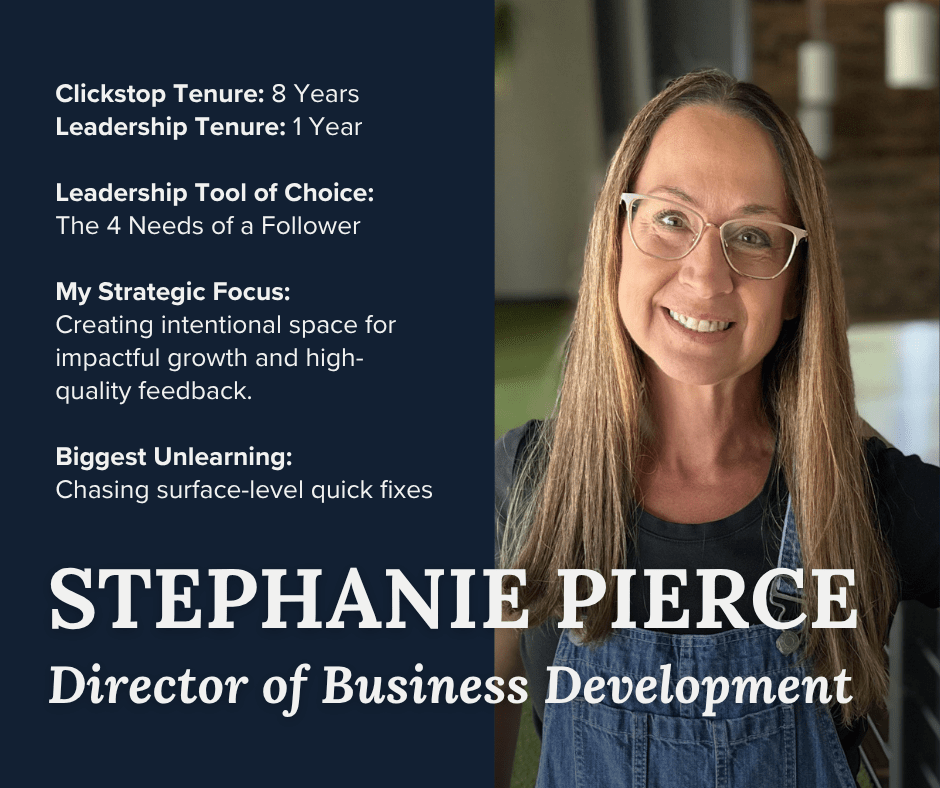
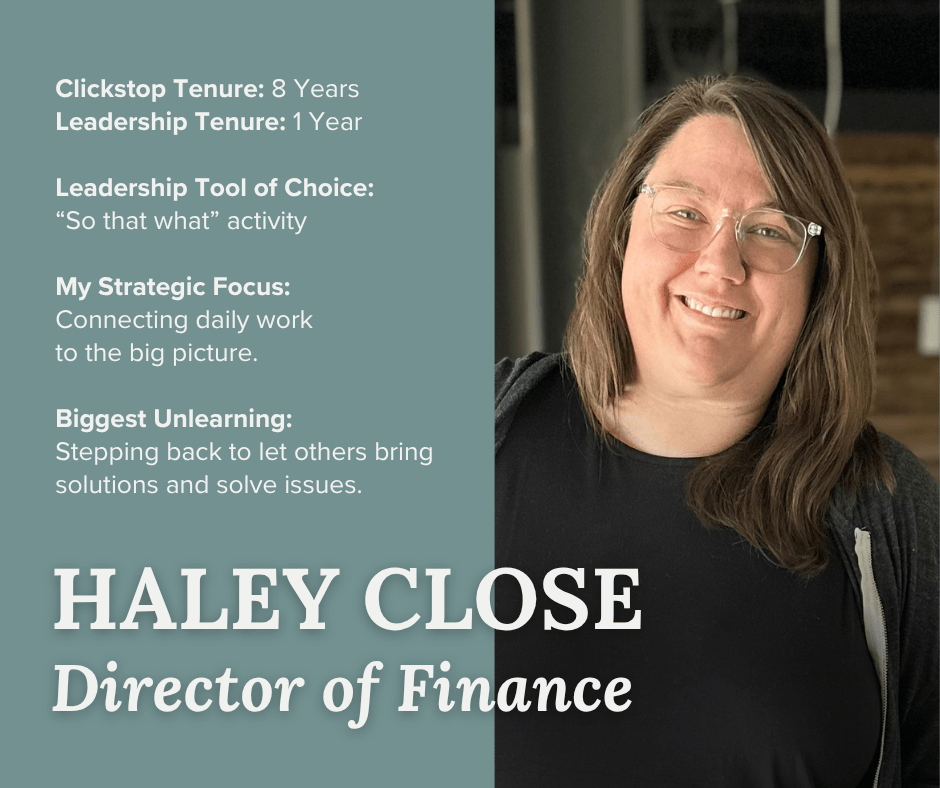
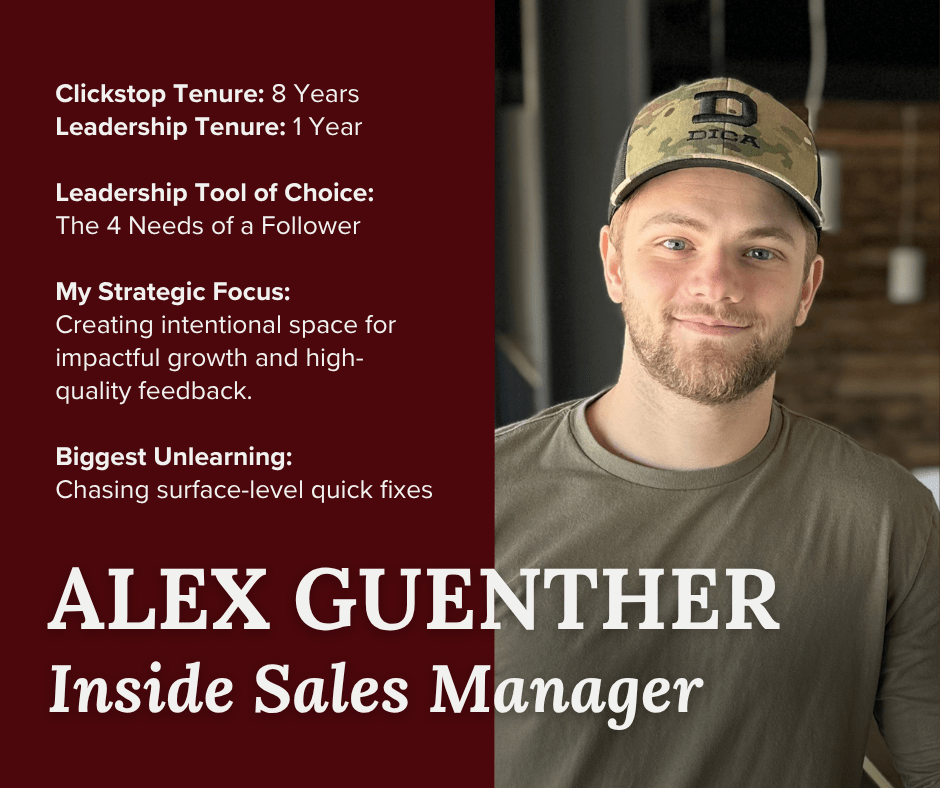
Getting Uncomfortable to Become Something Different
True growth requires a willingness to become new and different. It requires getting uncomfortable. For leaders who want to coach rather than just manage tasks, that means coming face to face with and intentionally unlearning deep-seated assumptions about what a “boss” is supposed to do.
“Thinking I have to do it all was a big behavior I had to unlearn,” shares Stephanie Pierce. “The culture we have here is just so different. Unlearning the past trauma of other jobs takes time for the brain to catch up and trust that people truly do have your back, and that it is okay to loosen the reins.”
For Haley Close, the challenge was fighting the natural urge to step in and solve everything. “I am a ‘fixer’ by design, and it can be hard for me to step back and let someone get there on their own,” Haley says.
Alex Guenther faced a similar hurdle in his daily sales environment. He realized he had a default habit of “solving problems at a surface level.” Through the program, Alex intentionally broke the habit of chasing quick fixes, pivoting instead toward driving sustainable growth and building deep trust amongst his team.
The Power in New Ways of Thinking
To shift from reactive fixing to meaningful mentorship, all three leaders leaned heavily on a core communication framework taught in Week 3 of the program: ORID (Objective, Reflective, Interpretive, Decisional). This tool gives leaders a structured path to ask intentional questions, leaving assumptions, and ego at the door to find real, solution-based outcomes.
“I will be Team ORID until the day I die,” jokes Haley. She recently used the tool during a conversation with a team member. By using the framework to step back and listen instead of immediately trying to fix the issue, she discovered new and important context to develop a fuller picture of the situation. Together, they built an actionable plan while also plugging in supportive resources to address the other issues the team member was facing.
Stephanie used ORID to heal an accidental divide that had formed between cross-functional teams. “Showing up to that meeting openly with the goal to understand made all the difference,” Stephanie notes. “It wasn’t a trust issue as we originally thought, but more of a need for understanding.”
Alex also integrated these communication tactics to dig deeper into team concerns. By combining the Four Needs of a Follower (Trust, Stability, Compassion, and Hope) with high-quality feedback loops, Alex shifted his entire approach. “It gave me a mindset of supporting my team when and where it makes sense, not just when it becomes urgent,” he says.
The Visible Ripple Effect on Our Teams
A key measurement of a leader’s development is the environment they create for their people. When Clickstop backs its leaders with organizational trust and resources, the investment multiplies directly through the teams they lead.
Sydney Boevers, an accounting teammate who experiences Haley’s leadership every day, has watched this evolution firsthand. “Haley’s energy is contagious and inspiring,” Sydney shares. “Our team is pausing to think and reflect. We are more organized in meetings, asking more questions, and doing a better job at making connections with how our work directly impacts others.”
Haley’s team recently put this into practice through a “so that what?” exercise during a team meeting.
By continuously asking “so that what?”, one particular employee connected the dots to a powerful ultimate conclusion: “I am responsible for accounts receivable so that Clickstop can keep cash flow going, so that our ESOP is successful, so that I can retire and enjoy life beyond the walls of Clickstop.” Suddenly, a routine administrative task became an act of ownership and connection to the big picture.
Lead the People. Drive the Culture.
Leadership at Clickstop is not a title to claim or a corporate ladder to climb. It is a shared responsibility to make ourselves, our teams, and our business better than we were yesterday.
By investing heavily in Stephanie, Haley, and Alex, we prove that our commitment to a values-driven environment is genuine. We don’t just ask our leaders to drive the culture on their own; we provide the backing, shared vocabulary, and support system they need to develop their teams effectively.
As Alex Guenther summarizes: “One thing I learned was to create an intentional space and make time for myself and my team to do focused work or have a focused discussion. It is okay to not always be in the work, if what we are creating space for inspires impactful growth.”